
Views: 0 Author: Site Editor Publish Time: 2025-07-28 Origin: Site


If you want to read radiograph images for your pet, first look at the image quality. Check if the labels are clear. Use a step-by-step way to find normal and abnormal shapes or shadows. Many pet owners look at radiographs at home. Stress during vet visits can make it hard to remember details. Practice will help you feel more sure. This guide will help you know when something looks wrong. It will also tell you when to ask your vet team for help.
Look at the radiograph image first to check if it is clear. This helps you see details and not make mistakes.
Always check the labels and view types before you start. This stops you from reading it wrong or mixing things up.
Learn what normal anatomy and densities look like. This helps you find shapes or shadows that do not look right.
Use a step-by-step way to look at the images. Check each part and compare both sides.
Ask your vet for help if you are not sure. If you see something strange in the radiograph, get advice.
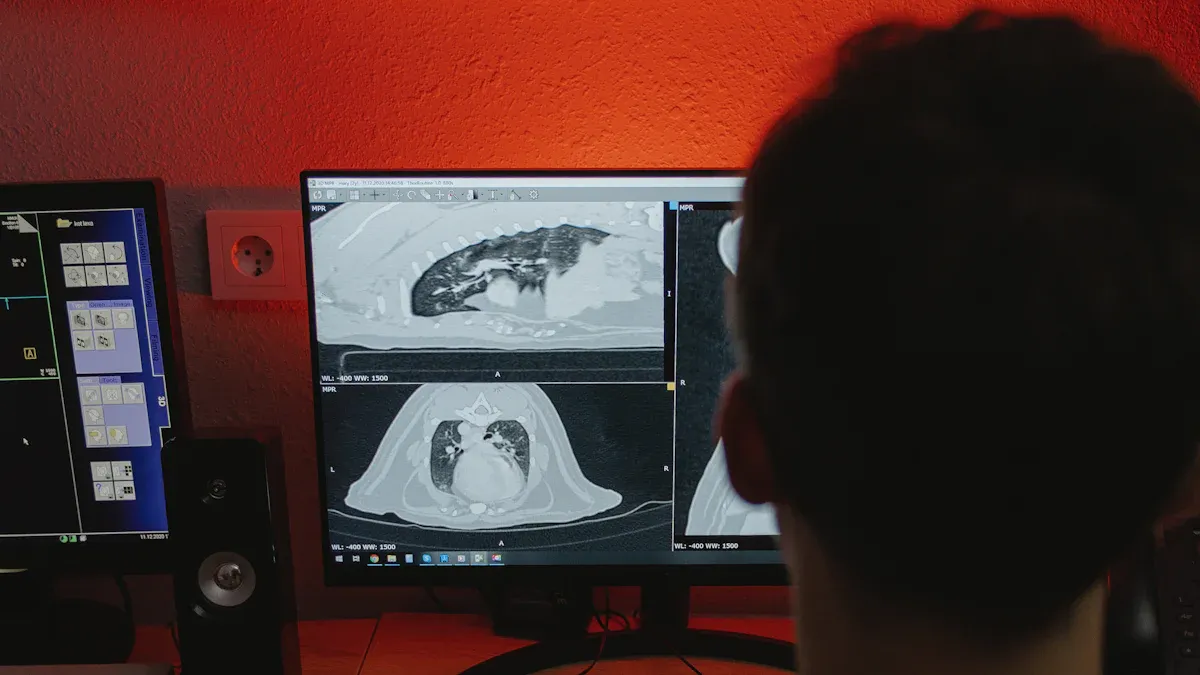
A radiograph is a special image that shows the inside of your pet's body. You may know it as an x-ray. When your vet takes a radiograph, they use a machine that sends x-rays through your pet. These x-rays pass through soft tissues but stop at dense things like bone or metal. The machine captures the pattern of x-rays that make it through, creating a picture you can see.
Here's how a radiograph gets made:
The machine releases electrons from a part called the cathode. This controls how many x-rays get made.
The machine sets how long the x-rays last. Longer times mean more x-rays.
The total number of x-rays depends on both the amount and the time. Changing one means you must adjust the other.
The machine uses high voltage to give x-rays more power. Higher power helps x-rays go through thicker parts but can make the image less clear.
The distance between the x-ray source and the film matters. A longer distance makes the x-ray beam weaker, so you need to adjust the settings.
You need to set these factors just right to get a clear, useful radiograph.
Radiographs help you and your vet see what is happening inside your pet. They work best for bones, teeth, and large body spaces. You can spot broken bones, arthritis, or swallowed objects. An abdominal radiograph can show if your pet has a foreign object or trapped air in the belly.
Let's compare radiographs to other tools vets use:
Imaging Modality | Best For | How It Works | Pros | Cons |
|---|---|---|---|---|
Radiographs (X-rays) | Bone, chest, teeth | X-rays pass through the body | Fast, affordable, no anesthesia | Not great for soft tissue |
Ultrasound | Soft tissue | Sound waves create images | Good for organs, real-time | Can't see through bone or gas |
CT | Deep structures | Many x-rays from different angles | Very detailed images | Needs anesthesia, expensive |
Radiographs give you quick answers. They help find broken bones, lung problems, or dental disease. You can use them to check the heart, lungs, or belly. They do not show soft tissues as well as ultrasound or CT. Still, they are the first step for many health problems in pets.
Reading a radiograph for your pet needs focus and simple steps. You can get better at this by following four main steps.
First, check if the radiograph is clear. Good images help you see small details and avoid mistakes. Always look at the radiograph in a dark room. Low light, about 25 to 40 lux, helps you see small changes. Try to use a medical-grade monitor. These screens show more detail and are brighter than normal ones. If you use a regular monitor, change the brightness and contrast.
Important things for image quality are:
Radiographic density: This tells you how dark or light the image is. It depends on the x-ray beam, tissue type and thickness, and how the image was made.
Contrast: This is the difference between the gray shades. High contrast helps you see bones and organs better.
Geometric detail: Sharp images matter. Collimation (making the x-ray beam narrow) cuts down scatter and makes things clearer.
Exposure settings: The right exposure keeps images from being too dark or too bright.
Tip: Good collimation and exposure settings help a lot. They lower scatter radiation and let you see more details.
Before you look at radiograph images, check the labels and view type. Labels should have your pet's name, the date, and which side is left or right. If labels are missing or wrong, you could read the image wrong.
Label or view mistakes can cause:
Wrong diagnosis or late diagnosis
Wrong-patient mix-ups that are hard to spot
Missed changes between radiographs
More stress for your pet and extra costs for you
Images that do not show the right spot or side
You will see different views like left lateral, right lateral, ventrodorsal (VD), or dorsoventral (DV). Each view shows different body parts. Always compare both sides for symmetry. For example, look at both lungs or both hips.
Note: Using a system and checking labels helps you avoid mistakes. Always double-check the view and patient info before you start.
To read radiograph images well, you need to know what normal anatomy looks like. Each view shows different landmarks. For example, in skull radiographs, you can find the tympanic bullae at the base of the skull or the ethmoid turbinates near the nose. The ventral surface of the mandible and the zygomatic arch also help you know where you are in the image.
Common landmarks include:
Landmark | Where to Find It | Why It Matters |
|---|---|---|
Tympanic bullae | Base of the skull (caudal end) | Helps with skull radiographs |
Ethmoid turbinates | In front of brain cavity | Shows nose and brain areas |
Mandible (lower jaw) | Runs from front to back | Good for jaw alignment |
Zygomatic arch | Side of the skull | Seen in DV views |
Nasal cavity & incisors | Front of the skull | Key for dental and nose checks |
You will also see different densities on a radiograph:
Bone: Looks white (very dense, stops x-rays)
Soft tissue/organs: Look gray (less dense)
Air: Looks black (x-rays go through easily)
Metal or contrast agents: Very bright white
Knowing these densities helps you find problems like broken bones, foreign objects, or strange air patterns in an abdominal radiograph.
A system helps you not miss important things. Always use the same order each time you read radiograph images. This builds good habits and helps you be more accurate.
Veterinary radiologists suggest these steps:
Check technical quality, including how the pet is placed and timing (like chest images at peak breath in).
Get more than one view, like right lateral, left lateral, and VD or DV, especially for chest radiographs.
Look at each area one by one. For chest images, check the chest wall, pleural space, lungs, and mediastinum.
Describe any strange spots by where they are before you talk about the pattern.
Use the "roentgen signs" to describe what you see:
Location
Margin
Number
Opacity
Shape
Size
Look at images in a quiet, dark room. If you can, ask someone else to look too.
Keep images in the same order every time. This helps you spot patterns.
Do not stop looking after you find one problem. Keep searching for more.
Write down your main findings and possible diagnoses.
Remember some breeds look different inside. Change your review if needed.
Tip: Practice helps you get better. The more you read radiograph images, the easier it is to spot normal and abnormal things.
You can use these steps for any radiograph, like thoracic radiographs or an abdominal radiograph. Always compare both sides for symmetry and look for anything unusual.
When you look at thoracic radiographs, you need to know the standard views. Each view gives you a different look at your pet's chest. Using more than one view helps you see all the important details.
Left lateral view: This view shows the right lung lobes best. Gravity makes the left lung lobes collapse a bit, so the right side stands out.
Right lateral view: This view highlights the left lung lobes. The right lung lobes collapse, making the left side easier to see.
Ventrodorsal (VD) view: This view lets you see both right and left lung lobes. It helps you find problems by giving a straight-on look at the chest.
Dorsoventral (DV) view: This view is great for checking the heart and blood vessels. It shows the vessels in the back part of the lungs.
You should always use at least two views for a full study. Each view can reveal something the others might miss. This approach helps you avoid mistakes and gives you a better chance to spot disease early.
Tip: Always check the labels on each view. Make sure you know which side is left or right before you start your review.
You will see many normal patterns on thoracic radiographs. These patterns can change with age, body type, or breed. Knowing what is normal helps you avoid mistakes.
Juvenile dogs and cats: You might see a visible thymus, a large heart, or a slightly big liver. These are normal for young pets.
Older or overweight pets: Fat can build up in the chest, making the space in front of the heart look wide. The heart may look bigger, but this can be normal for older or heavy pets.
Thin older cats: Their lungs may look more inflated than usual.
Breed differences: Bulldogs often have a narrow windpipe and extra fat in the chest. Athletic breeds like Labradors may have a rounder heart or a bigger right side of the heart.
You should not mistake these normal findings for disease. Always think about your pet's age and breed when you look at thoracic radiographs.
Abnormal findings can show up in many ways. Some of the most common problems include:
Pleural effusion: This means fluid in the chest. You will see extra soft tissue shadows and lines between the lung lobes. The lungs may look pushed apart. Fat in the chest can look similar, but it spreads out differently.
Mediastinal changes: You might see fluid, air, or masses in the middle of the chest. The windpipe may shift or collapse. The esophagus can get big, or lymph nodes may push on the airways.
Heart changes: The heart may look too small or too big. You might see one chamber get larger.
Lung changes: The lungs can look too dark (overinflated) or too light (filled with fluid or infection). You may see patterns that suggest pneumonia, cancer, or bleeding.
Other signs: You might see nodules, abscesses, or signs of blood clots.
Note: Always compare what you see to what is normal for your pet's age and breed. If you see something strange, check other views to confirm.
Here is a table that shows how different views help you measure the heart and spot disease:
Radiographic View(s) | Cardiac Measurement(s) | Diagnostic Accuracy | Sensitivity | Specificity | Notes |
|---|---|---|---|---|---|
Lateral (L) | Vertebral Heart Score (L-VHS) | High (AUC ~0.91) | 0.91 | 0.82 | Best single-view accuracy |
Lateral (L) | Cardiac Long Axis (L-CLA) | Nearly high (AUC ~0.89) | N/A | N/A | Shows left atrial size |
Lateral (L) | Cardiac Short Axis (L-CSA) | Nearly high (AUC ~0.90) | N/A | N/A | Shows left atrial size |
DV / VD | Vertebral Heart Score (DV/VD-VHS) | Moderate | 0.64–0.81 | 1.00 | High specificity |
Combined L + DV/VD | Multiple indices combined | Improved | N/A | N/A | Best with multi-view |
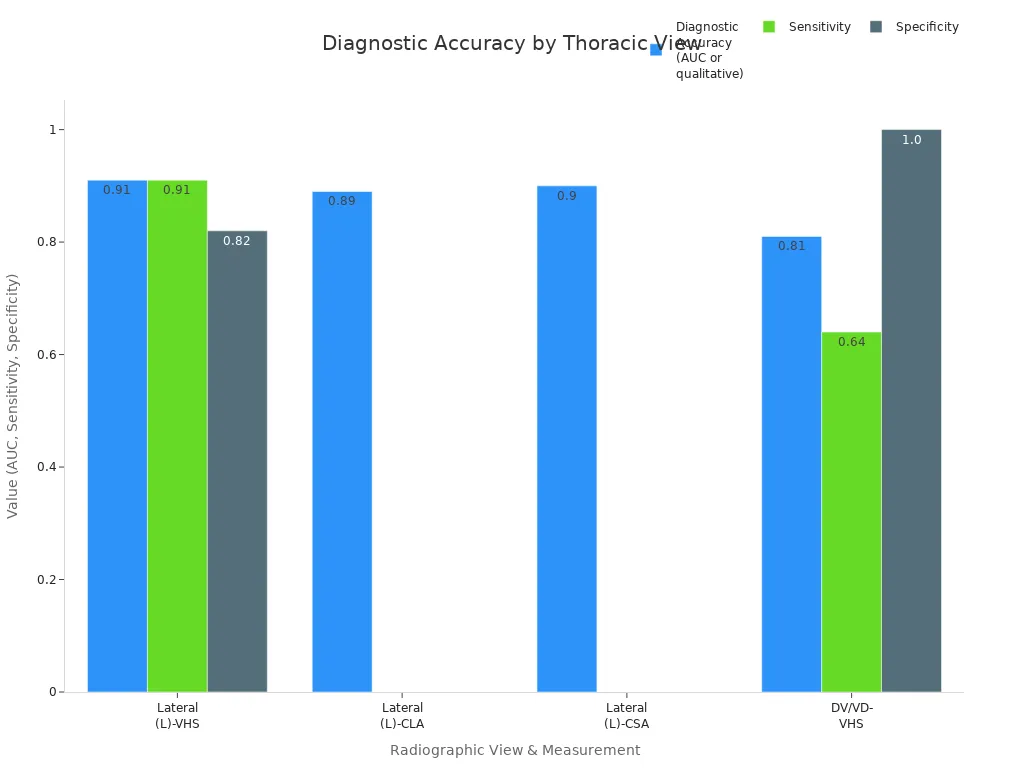
Using more than one view gives you a clearer picture. It helps you spot heart problems and lung disease more accurately. You can see how each view adds new information.
You need to compare both sides of the chest when you read thoracic radiographs. This step helps you find problems that affect only one side or look different on each side.
You can use these steps to check for symmetry:
Look at the right and left lungs. Check their size and shape.
Notice any differences in the amount of air or tissue on each side.
Watch for lines or shadows that only show up on one side.
Use the same landmarks on both sides to help you compare.
If you have access to computer tools, some systems can measure the lung areas and spot differences for you.
When you see a big difference between the two sides, it may mean disease. For example, one lung may look smaller if it has collapsed. Fluid or masses can push the lungs apart or make one side look cloudy.
Tip: Always compare the same spots on both sides. If you see something odd, check other views to confirm.
Sometimes, you need more than thoracic radiographs. CT scans can help when you need a closer look. CT finds small lung nodules or masses that x-rays might miss. Vets use CT mostly for cancer checks or complex chest problems. It costs more and needs special equipment, so most vets start with thoracic radiographs first.
You can get better at interpretation of thoracic radiographs by practicing these steps. Always use a system, compare both sides, and use more than one view. This approach helps you find problems early and keeps your pet healthy.
You can stop many mistakes when reading pet radiographs by using easy steps. People often make mistakes because they hurry or skip checks. Here are the most common mistakes:
Using bad exposure or wrong positioning.
Not taking all three standard views.
Thinking normal patterns are abnormal.
Mixing up types of lung disease.
Not seeing air or fluid in the chest.
Thinking normal fat is a disease.
Reading the heart's shape or size wrong.
Not knowing breed differences.
Not knowing basic radiographic anatomy.
Tip: Always check if the image is good before you start. Make sure you have the right views and clear labels.
A checklist can help you stay on track. Try to read radiographs in a quiet place. Take breaks if you get tired. Being tired can make you miss things. If you are not sure, ask a veterinary professional for help.
A table can help you remember what to check:
Step | What to Look For |
|---|---|
Image Quality | Exposure, motion, positioning |
Views | Right lateral, left lateral, VD |
Anatomy | Landmarks, symmetry |
Patterns | Compare both sides |
Sometimes, you may not feel sure about what you see. You should ask for help in these cases:
You see something you do not know.
The image looks blurry or strange.
Your pet's symptoms do not match the radiograph.
You see a big change from old images.
You can ask your veterinary team to look at the radiographs. Some clinics use smart tools like AI to help with interpretation. Do not be afraid to ask questions. Talking with your vet helps stop mistakes and keeps your pet safe.
Note: If you are not sure, it is always best to ask a veterinary expert. They know how to find small problems and can tell you what to do next.
By staying organized and asking for help when you need it, you can get better at reading radiographs and keep your pet safe.
You can build strong radiograph reading skills by following a step-by-step approach. Compare normal and abnormal images to spot changes and avoid mistakes. This habit helps you understand what is healthy and what needs attention.
If you feel unsure, talk to your veterinarian. They can guide you or suggest more tests.
You can join hands-on labs or online courses to keep learning. These options give you real cases and expert tips. Practice often, ask questions, and you will grow more confident each time.
You can look for a clear line or gap in the bone. The edges may not line up. Sometimes, the bone looks bent or out of place. If you see swelling, it may also mean a break.
Radiographs show shades from black to white. Here is a quick guide:
Shade | What It Shows |
|---|---|
Black | Air |
Dark gray | Fat |
Light gray | Soft tissue/organs |
White | Bone or metal |
You can view radiographs on a phone or tablet, but details may be hard to see. A medical monitor or computer screen works better. If you must use a phone, increase the brightness and find a dark room.
You should ask your vet if you feel unsure, see something strange, or if your pet's symptoms do not match the image. Vets have special training. They can explain what you see and suggest the next steps.


