
Views: 0 Author: Site Editor Publish Time: 2025-09-23 Origin: Site


When you want to find the best way to achieve intraoperative hemostasis during surgery, new studies show that advanced bipolar vessel sealing works very well. In a study with 314 vessel cuts, this method stopped bleeding to a grade three or less in 96.2% of cases. Additionally, 86% of the cases had no bleeding at all. The way you stop bleeding during surgery depends on the type of surgery, what your patient needs, and what tools you have. Suture and clips are still helpful, but advanced bipolar vessel sealing is now leading the way in surgical care.
Advanced bipolar vessel sealing devices work very well. They stop bleeding in more than 96% of cases. This makes them a top choice for many surgeries.
Sutures close wounds tightly but need skill and time. Clips are fast but might not close big vessels all the way.
Picking the best hemostasis method depends on what the patient needs. It also depends on the surgery type and the surgeon's skill with the tools.
Energy sealing devices can make surgery faster and lower blood loss. This helps patients heal quicker and saves hospitals money.
Using sutures, clips, and energy sealing devices together can help surgeries go better. This gives doctors more choices and control during surgery.
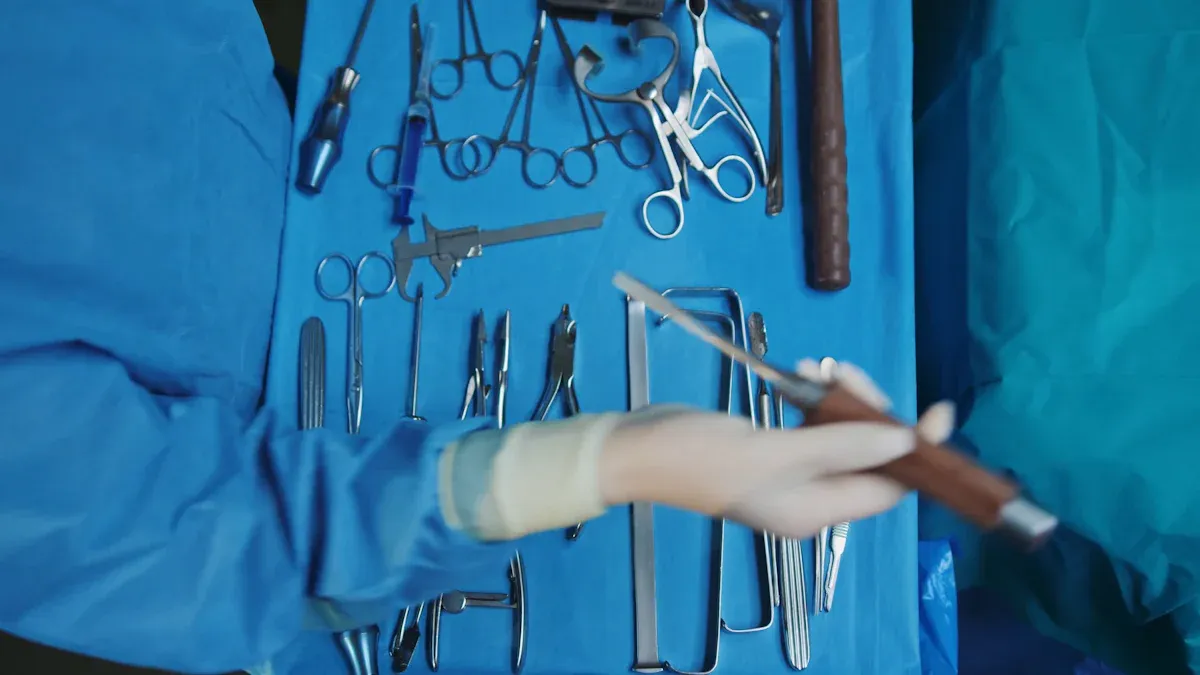
When you look at suture, clips, and advanced bipolar vessel sealing devices, you notice they work differently in surgery. Picking the best one depends on what you want for safety, speed, cost, and how well it works. The table below shows the main features of each method.
Method | Efficacy | Safety | Speed | Cost | Versatility |
|---|---|---|---|---|---|
Suture | High (operator-dependent) | High (with skill) | Slow | Low | High |
Clips | Moderate-High | Moderate-High | Fast | Moderate | Moderate |
Advanced Bipolar Vessel Sealing | Very High | Very High | Very Fast | Moderate-High | High (procedure-dependent) |
You want to stop bleeding well in every surgery. Suture works well, but you need skill to use it. Clips work for small and medium vessels, but sometimes do not close them all the way. Advanced bipolar vessel sealing devices work very well, even in total laparoscopic hysterectomy. Studies show energy devices do better than old methods in many surgeries. Reviews found that advanced bipolar vessel sealing had better results and fewer problems in total laparoscopic hysterectomy. These devices give steady results in different surgeries. You can count on them to close vessels, even in hard cases.
Safety is always most important. Suture has been safe for a long time, but you must be careful. Clips are usually safe, but they can move and cause problems. Advanced bipolar vessel sealing devices use energy to close vessels. This helps keep nearby tissues safe from heat. The table below shows how safe each device is:
Device Type | Maximum Vessel Size | Maximum Temperature | Safety Profile Description |
|---|---|---|---|
Ultrasonic Scissors | Up to 5 mm | ~200 °C | Good at sealing but can hurt nearby organs with heat. |
Advanced Bipolar Clamps | Up to 7 mm | <100 °C | Makes less heat, but does not cut at the same time, so it takes longer. |
Harmonic ACE® | Up to 5 mm | ~200 °C | Like ultrasonic scissors, gets hot but is used often. |
LigaSure V® | Up to 7 mm | <100 °C | Uses pulsed energy, stays cooler, and seals well. |
You can also see the safety differences in this chart:
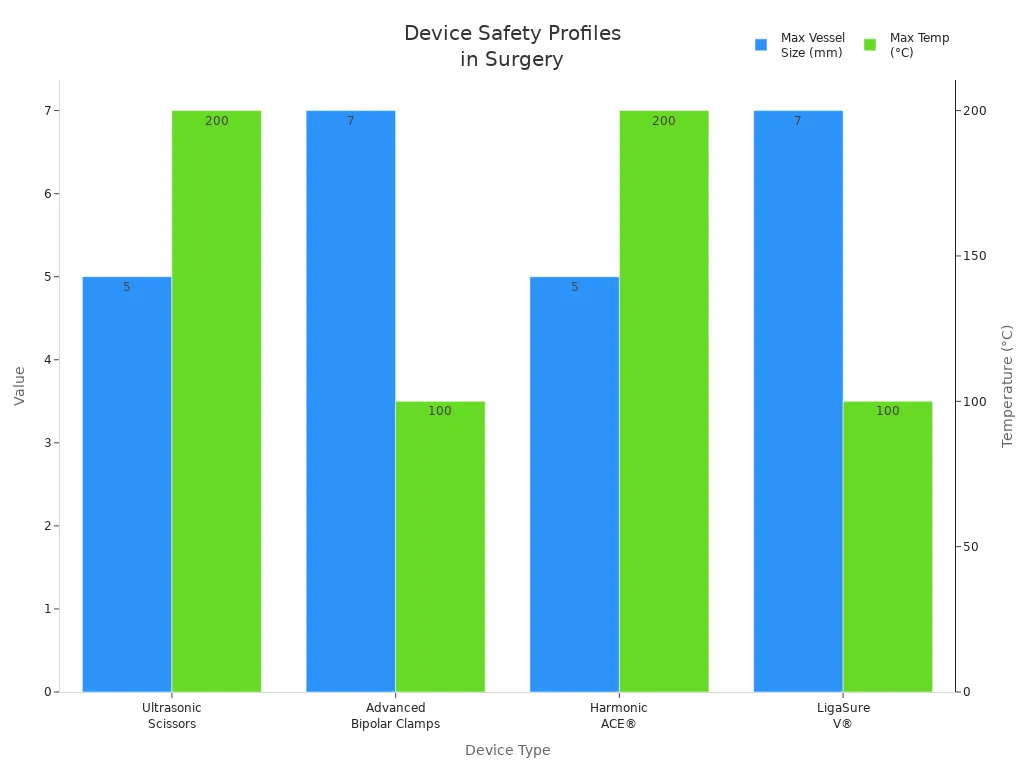
Reviews show that advanced bipolar vessel sealing devices lower the chance of problems, especially in total laparoscopic hysterectomy. These devices stay cooler than ultrasonic scissors, which helps protect other tissues. Picking the right device can help you avoid problems.
Speed is important in surgery. Suture takes longer because you have to tie knots. Clips are faster, but you might need more for big vessels. Advanced bipolar vessel sealing devices save time by sealing and cutting at once. Studies show energy devices make surgeries faster, especially in total laparoscopic hysterectomy. Faster surgeries mean less time under anesthesia and fewer risks for patients. Using these devices can help you work faster and better.
Cost matters for hospitals and clinics. Suture is cheap, but longer surgeries can cost more. Clips cost a bit more, and you may need many for one surgery. Advanced bipolar vessel sealing devices cost more at first. But studies show they can save money overall. Shorter surgeries and fewer problems mean you spend less on anesthesia and recovery. Some studies show big savings with energy devices compared to old methods. Even though disposable devices cost more, the savings from fewer problems and faster surgeries can be worth it.
Studies show LigaSure or ultrasonic devices can cost less than monopolar scissors because surgeries are faster.
One study found big savings with LigaSure or ultrasonic devices over monopolar scissors.
Another study showed LigaSure might save money, but it was not a big difference.
Even though disposable devices cost more, hospitals spent less overall because surgeries were faster.
You need tools that work for many surgeries. Suture works almost anywhere, but you need skill and time. Clips are easy to use, but do not fit every vessel. Advanced bipolar vessel sealing devices work well in many surgeries, especially in minimally invasive ones like total laparoscopic hysterectomy. Reviews show these devices are great for laparoscopic surgeries, giving safety and accuracy. But how well they work depends on the surgery. Some devices are made for special surgeries, which makes them more useful.
How well advanced bipolar vessel sealing devices work depends on the surgery.
Studies show these devices are best in minimally invasive surgeries, like total laparoscopic hysterectomy.
The good and bad points of these devices do not fit every surgery, so you need to check for each case.
Different vessel sealing devices are made for special surgeries, making them more useful.
Bipolar devices are often used in laparoscopic surgeries, giving safety and accuracy.
Ultrasonic vessel sealing devices make less heat, so they are good for delicate tissues.
Reviews support using advanced bipolar vessel sealing devices in total laparoscopic hysterectomy and other minimally invasive surgeries. You can pick the best method by thinking about the surgery, what the patient needs, and what tools you have.
Sutures help stop bleeding during surgery. You put a thread around the vessel. Then you tie a knot to close it. The knot blocks blood from coming out. You can use sutures in open or small surgeries. During dissection, you need to stop bleeding from vessels. Sutures let you fix the exact spot that bleeds. You can pick different threads and knots for each case.
Sutures have many good points for stopping bleeding:
Tensile strength: Sutures stay strong when pulled. This helps keep bleeding under control.
Knot security: A tight knot keeps the vessel closed. It does not slip, even if you move tissues.
Handling characteristics: You can move sutures easily. This helps you reach deep or tricky spots.
These good points make sutures a trusted choice for many surgeries.
You need skill to use sutures well. You must learn how to tie knots right, especially in hard surgeries. Suturing can take longer than other ways. This may make surgery last more time. Sometimes, using sutures in deep or tight spaces is hard. If you tie the knot wrong, bleeding can keep going. You also need to pick the best thread for each case to avoid problems.
Doctors use sutures a lot to stop bleeding. They are common in women's surgeries. You can use sutures in almost any surgery. They work for small and big vessels. Careful technique is needed for good results. Many times, sutures help when other ways do not work.
Sutures give steady results for stopping bleeding. Studies show sutures work well for blood loss and problems. The table below shows some usual results:
Outcome Measure | Result |
|---|---|
Average Postoperative Hemoglobin Level | 108 ± 12 g/L |
Length of Postoperative Hospital Stay | 3.8 ± 1.1 days |
Different suture ways do not change blood loss much. There is no big difference in blood loss, blood given, or problems. Problems like uterine necrosis are rare and about the same for all ways.
Outcome Measure | Result |
|---|---|
Intraoperative Blood Loss | No big difference between suture ways (P > 0.05) |
24-h Postoperative Blood Loss | No big difference between suture ways (P > 0.05) |
Blood Transfusion Volumes | No big difference between suture ways (P > 0.05) |
Complication Rates | Similar results with no big difference in problems |
In 48 cases, average blood loss was 865 ± 1176 ml. The most was 8000 ml, and the least was 300 ml. About 18.8% lost over 1000 ml of blood. No one had heavy bleeding after or infections. This shows sutures work well for stopping bleeding.
Clips help stop bleeding fast. You use a special tool to put the clip on a vessel or tissue. The clip squeezes tight and blocks blood flow. Clips are used in many surgeries. Here are some ways clips help:
You tie off blood vessels to stop bleeding.
You seal the base of the appendix.
You close the cystic duct and artery.
You secure vessels during bowel surgery.
You control blood vessels in kidney surgery.
You secure fallopian tubes in tubal ligation.
You seal vessels in gastric bypass.
You manage vessels in chest and heart surgeries.
Clips work fast and are reliable. They help in many situations. Studies show clips have high success rates. The table below shows results from different studies:
Study | Patient Group | Clinical Success Rate | Adverse Events Rate | Follow-up Period |
|---|---|---|---|---|
Manno et al | High-risk non-variceal upper GI hemorrhage | 100% | 0% | 30 days |
Wedi et al | High-risk patients with non-variceal GI bleed | 86% | N/A | 6 months |
Wedi et al (compare) | OTSC vs standard care | OTSC: 10.9% rebleed, Standard: 27.9% rebleed | N/A | N/A |
Systematic Review | GI hemorrhage cases | 86.0% | 1.6% needed surgery | N/A |
Clips give you a quick way to stop bleeding. They work well in emergencies.
There are some problems with clips:
Some types can cause bleeding again.
Some clips cost more than other devices.
It can be hard to place clips in small or tricky spots.
Clips are used in many surgeries. They save time and make work easier. Here are some examples:
Surgical Procedure | Type of Clip Used | Purpose |
|---|---|---|
Colectomy | Metal Clips | Tie off vessels |
Neck Dissection | Metal Clips | Tie off vessels |
Instrument Name | Function | Benefits |
|---|---|---|
Week Hemoclip | Places two clips at once | Saves time and makes work easier |
Clips help stop bleeding very quickly. Most patients stop bleeding in minutes. The table below shows how fast clips work:
Treatment Group | Complete Hemostasis after 3 min | Complete Hemostasis after 5 min | Complete Hemostasis after 10 min | Median Time to Hemostasis |
|---|---|---|---|---|
COLL | 86.9% | All but one patient | All but one patient | 2.2 min |
CBFS | 80.0% | All but one patient | All but one patient | 3.4 min |
You can count on clips for quick and strong bleeding control in many surgeries.
Advanced bipolar vessel sealing devices help control bleeding in surgery. These devices use energy on blood vessels. The energy heats the tissue and changes proteins. This seals the vessel walls together. Shinova's veterinary vessel sealing generator and electrosurgical unit work like this:
Functionality | Description |
|---|---|
Vessel Sealing | Seals large blood vessels well |
Electrosurgical Modes | Has 3 monopolar excision, 2 monopolar coagulation, 2 bipolar output |
Safety Features | Checks for high frequency leakage with a built-in monitor |
You can control these devices very well. The energy changes to match the tissue. This helps seal vessels fast and safely.
Advanced bipolar vessel sealing devices have many good points.
They work better with fewer incomplete cuts and sticking.
Seal times are faster than other devices.
Less heat spreads to nearby tissues, keeping them safer.
Surgeries take less time, which helps patients get better results.
Shorter surgeries lower the chance of infections.
The special jaw design lets you see better and work in small spaces.
Less heat spread means less harm to other tissues.
There are some problems with these devices.
Limitation | Description |
|---|---|
Collateral Damage | Controlled heat does not fully stop harm to nearby tissue. |
Thermal Spread | Ligasure can spread more heat than ultrasonic devices. |
Nerve Proximity Risks | Using ligasure close to nerves (within 3 mm) can cause paralysis. |
Unintended Sealing | The device may seal tissue layers you do not want to seal. |
Risk of Severe Bleeding | Sealing big vessels with energy can cause heavy bleeding. |
Influence of Vessel Diameter | The size of the vessel changes how safe the device works. |
You can use advanced bipolar vessel sealing devices in many surgeries.
Laparoscopic colectomy
Hysterectomy
Lymphadenectomy
Organ resections
These devices help seal vessels in open and small surgeries.
You get better results with advanced bipolar vessel sealing devices. Studies show less blood loss during abdominal hysterectomy than with sutures. There is also less blood loss in laparoscopic subtotal hysterectomy than with other energy devices. Ligasure makes surgery time shorter, so patients spend less time asleep. The need for blood transfusions goes down with these devices. Patients feel less pain after surgery. Most studies show advanced bipolar vessel sealing lowers blood loss and makes surgery faster in many cases.
When doctors do a hysterectomy, they need to stop bleeding fast and safely. They can use suture, clips, or energy sealing devices. Each way works a bit differently.
Suture has been used for a long time. The doctor ties blood vessels by hand. This works well but takes more time and skill. There may be more blood loss and longer surgeries. Clips help close vessels faster. They are simple to use, but sometimes do not close big vessels all the way.
Energy sealing devices have changed how hysterectomies are done. Studies show these devices make surgery quicker and reduce blood loss. One study showed vessel sealing made surgery last about 27 minutes. With suturing, it took about 34 minutes. Blood loss was 111 mL with vessel sealing. With suturing, it was 320 mL. More than 83% of cases had no bleeding with vessel sealing. Patients heal faster and feel less pain after surgery. They stay in the hospital for less time and have fewer problems.
If you want the best results in hysterectomy, energy sealing devices give you speed, safety, and strong vessel closure.
Pancreatic surgery is hard because there are many small vessels. Doctors must stop leaks and bleeding. They can use suture, clips, or energy sealing devices.
Energy devices seal small branches of the pancreatic duct. This helps lower the chance of a pancreatic fistula.
Metal clips are put on the main pancreatic duct. This stops leaks and keeps the area dry.
Suture is used for extra safety, especially for big vessels or ducts.
When you compare these ways, surgery time and blood loss are about the same. Studies show using LigaSure or regular dissection gives similar results. The cost is a little higher for energy sealing devices, but not by much.
Technique | Operation Time | Blood Loss | Postoperative Outcomes | Cost |
|---|---|---|---|---|
LigaSure | No difference | No difference | No difference | €3,527 |
Conventional Dissection | No difference | No difference | No difference | €3,047 |
Doctors pick the method that fits the patient and surgery goals. Energy sealing devices seal small branches quickly. Clips work well for the main duct. Suture gives extra control when needed. Using all three can give the best results in pancreatic surgery. This helps lower problems and improve how patients do after surgery.
Vascular procedures mean stopping bleeding from arteries and veins. Doctors can use suture, clips, or energy sealing devices. Each has good and bad points.
Device Type | Mechanism of Action | Key Findings |
|---|---|---|
Collagen Plug | Augments haemostasis via collagen exposure | Works well for patients who do not need immediate re-access. Watch for local infection. |
Clips | Mechanical closure at the arteriotomy site | Easy to use. Gives you rapid hemostasis. Complication rates are similar to manual compression. |
Energy Sealing | Uses thermal energy for sealing | Still in clinical trials. Aims to close vessels without relying on the body's clotting ability. |
Clips are often used for quick closure at the end of surgery. They are easy to put on and work fast. Suture lets doctors control the closure better, but it takes longer. Energy sealing devices are newer for these surgeries. They use heat to close vessels and may work even if the patient has trouble clotting. Doctors need to watch for problems like infection or vessels not closing all the way, especially with new devices. They pick the way that matches the patient's risk and the type of surgery.
Soft tissue procedures include many surgeries, like removing tumors or fixing injuries. Doctors can use suture, clips, or energy sealing devices.
Energy sealing tools have gotten better fast. Now there are ultrasonic shears and electrothermal bipolar graspers. These help finish surgery faster and lower pain after.
New designs and systems make these surgeries work better. Doctors can use different tools together for better results.
Studies show energy devices can save money. Ethicon energy devices save about $101 per surgery by making surgeries and hospital stays shorter.
Both ultrasonic and bipolar electrosurgical tools seal vessels as well as clips or ligatures. There is little difference in how strong the seals are or how long it takes.
Doctors pick the way that fits the surgery and patient. Energy sealing devices help doctors work faster and lower problems. Clips and suture are still useful, especially for extra control or in small spaces. Modern energy devices give steady results in soft tissue surgeries.
Tip: For soft tissue surgeries, energy sealing devices help save time, lower pain, and reduce problems. You can use them with suture or clips for the best results.
You need to think about the patient first. Every patient is not the same. Some are older or have low body weight. These things can make them get cold during hysterectomy. Getting cold makes blood clot slower. This can lead to more bleeding. You should check if the patient takes medicine that affects bleeding. Some medicines make blood clotting harder. You must know the patient's health and risks before you choose how to stop bleeding.
Body temperature and blood clotting
Medicines that change bleeding risk
Chance of getting cold during hysterectomy
Age and body weight
The kind of hysterectomy changes what tool you pick. Some types need more control. Others need you to work fast. If you do a minimally invasive hysterectomy, you may want a tool with good control and less heat. Advanced bipolar vessel sealing devices work well for these cases. If you work with big vessels, you need a tool that seals tightly. Your choice also depends on what you like to use.
Type of hysterectomy
Size of vessels
Your comfort with the device
Good sealing stops blood loss.
Hemostasis keeps the area clear.
New tools help you do better.
You need to think about cost when you choose a tool. Some tools cost more at first. Advanced bipolar vessel sealing devices may cost more, but they can save money later. They make surgery faster and safer. This means less time in the hospital. Sutures cost less, but take more time. Clips cost more than sutures but less than some energy devices. You should look at what your hospital has and what you can pay.
Tip: Spending more on a good device can save money later.
Your skill with each tool matters a lot. If you have used sutures for years, you may work faster with them. If you know how to use advanced bipolar vessel sealing devices, you can finish surgery quickly and safely. Training helps you use new tools. You should pick the method you know best. Shinova offers devices that are easy to learn and use. This helps you do a better job every time.
Remember: The best tool is the one you use well.
You want to pick the best way to stop bleeding. Advanced bipolar vessel sealing devices often work best in new surgeries. You should think about what your patient needs. You should also look at the kind of surgery and your own skills. New studies show these devices help you get better results and work faster. Always look for new tools and think about the surgery to help your patients do well in both animal and human surgeries.
You can close vessels faster and more reliably. These devices help lower blood loss. They also make surgery time shorter. Many surgeons pick them for safety. They also like how well they work.
Yes, you can use all these methods together. Sutures work well for big vessels. Clips are good for medium vessels. Vessel sealing devices help with small or hard-to-reach vessels. Using all three gives you more choices during surgery.
You can use these devices in many types of surgeries. Always check the device's instructions first. Think about what your patient needs. Some surgeries need extra care near nerves or delicate tissues.
Look at what kind of surgery you are doing. Think about your patient's health. Check what tools you have. Your skill with each method matters too. Pick the way that gives you the most control and safety.


