
Views: 0 Author: Site Editor Publish Time: 2025-07-21 Origin: Site


Veterinarians rely on X-rays to diagnose fractures in dogs quickly and accurately. X-rays provide clear images of dog bones, allowing vets to determine the best course of treatment promptly. Research shows that both expert and novice radiologists achieve about 82% sensitivity and over 99% specificity when using X-rays to diagnose fractures in dog ribs. Most dog owners notice signs like pain or limping and seek help immediately, trusting that X-rays diagnose fractures effectively. This reassurance helps families feel confident that their pets receive safe and accurate care.
X-rays help vets find most bone breaks in dogs. They show clear pictures of bones. The X-ray process is safe and quick. Dogs usually do not need to get ready or fast before X-rays. X-rays work best for common bone breaks. But they can miss small cracks or injuries in hard-to-see places like the skull or spine. If X-rays are not clear, vets use CT or MRI scans. These scans give more detailed pictures and help find hidden breaks. Finding breaks early with X-rays helps vets pick the best treatment. This helps dogs heal and get better faster.
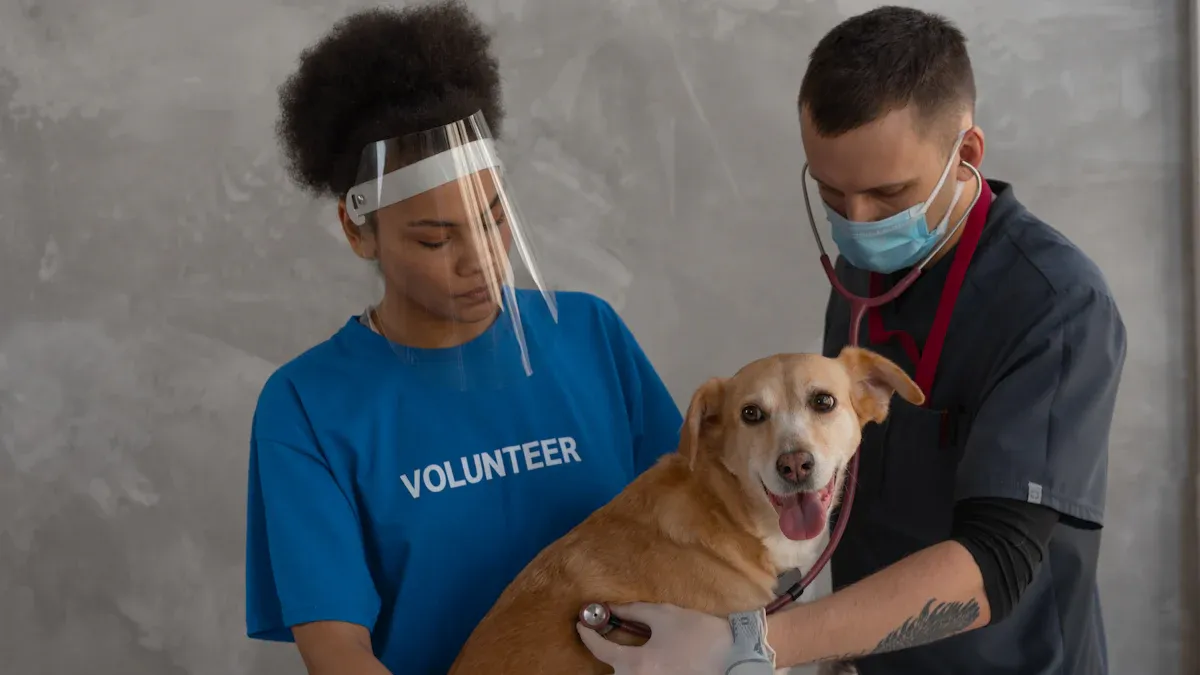
Veterinarians use x-ray machines to look inside a dog's body. The machine sends a quick burst of x-rays through the dog. Bones are dense and absorb more x-rays, so they look white on the image. Softer tissues, like muscles or fat, let more x-rays pass and look darker. This difference in color helps veterinarians find problems fast.
Pet radiology uses this technology because it is not expensive, easy to move, and simple to use. Most clinics have x-ray machines ready for emergencies. The images help veterinarians see if a dog has a broken bone or another injury. They usually take at least two pictures from different sides to make sure nothing is missed. Sometimes, dogs need sedation if they are in pain or cannot stay still.
The x-ray machine works by sending fast electrons to hit a metal target inside. This makes x-ray photons and heat. The photons go through the dog's body and make a clear picture on a screen or film. Pet radiology uses this way to check for fractures, arthritis, and other bone problems. It is still the main choice for finding bone fractures in dogs.
Veterinarians trust x-rays to find fractures in dogs. They use pet radiology as the main tool for this job. X-rays show clear breaks or cracks in the bone. The images show if the break goes all the way through or only partway. They also show if the bone has split into many pieces.
Common fracture types that x-rays find include:
Complete fractures: The bone breaks all the way through.
Comminuted fractures: The bone shatters into several pieces.
Salter-Harris fractures: The break happens at the growth plate, often in young dogs.
Articular fractures: The break affects the joint surface.
Open (compound) fractures: The bone breaks through the skin.
Closed fractures: The bone breaks but the skin stays intact.
Greenstick fractures: The bone bends and cracks, but does not break completely.
Veterinarians often use two or more views, like side and top-down, to make sure they do not miss hidden fractures. Pet radiology helps them see everything and plan the best treatment. X-rays find fractures in the cortex, growth plates, and joints with high accuracy. They also help confirm the type and how bad the injury is.
Fracture Type | Description | X-ray Detection |
|---|---|---|
Complete | Full break through bone | Easy |
Comminuted | Multiple bone fragments | Easy |
Salter-Harris | Growth plate involvement | Easy |
Articular | Involving joint surfaces | Easy |
Greenstick | Partial break, common in young dogs | Moderate |
Open (Compound) | Bone breaks through skin | Easy |
Closed | Bone breaks, skin intact | Easy |
Sometimes, x-rays do not work as well in some areas. Skull fractures, especially near suture lines or where bones meet, can be hard to see. In these cases, veterinarians may use other imaging tools, but x-rays are still the first step for finding bone fractures.
Veterinarians want dogs to feel safe before x-rays. Most dogs do not need to do anything special. Owners might hear these steps from the veterinary team:
The veterinarian checks the dog and talks about the x-ray.
Sedation may be used if the dog is nervous, cannot stay still, or feels pain.
If the dog is calm, sedation is not needed.
Fasting is not needed unless the veterinarian says so.
Tip: Owners should ask questions if they are unsure. The veterinary team will explain the steps in a simple way.
The x-ray is quick and safe. The staff follows safety rules to protect everyone.
The dog goes on the x-ray table, sometimes with soft pads or sandbags.
Sedation helps some dogs relax, so the pictures are clear.
Staff wear special gear, like lead aprons and thyroid collars, and leave the room if they can.
The x-ray machine takes pictures from different sides to show the bone.
The whole process usually takes just a few minutes.
Step | What Happens |
|---|---|
Positioning | Dog put on table, soft supports used if needed |
Sedation | Used if dog is nervous or hurting |
Safety Measures | Staff wear special gear, try to avoid exposure |
Imaging | X-ray pictures taken from more than one angle |
Veterinarians look at the x-ray pictures right after the test. They check for lines or spaces in the bone and look for swelling or other changes. They use two views to see the injury from different sides. Board-certified radiologists or skilled veterinarians can find the type and place of the fracture. They use this to decide the best treatment for the dog.
Note: Most clinics give a first report at the end of the visit. Full reports for normal cases are ready in 24 hours. Urgent cases get results in about two hours.
X-rays help vets find most bone fractures in dogs. They use X-rays because they work fast and show bones clearly. Many times, X-rays show a break or crack right away. Vets trust X-rays for most limb and joint injuries.
But X-rays are not always perfect. How well they work depends on where the fracture is and what kind it is. Sensitivity means how often X-rays find a fracture when it is there. Specificity means how often X-rays say there is no fracture when the bone is fine. Studies say X-rays work well for many fractures, but not all.
Diagnostic Method | Animal Model | Sensitivity (%) | Specificity (%) | Notes |
|---|---|---|---|---|
Radiography (X-rays) | Canine (spinal trauma) | 72 | N/A | Moderate interobserver variability; low negative predictive value for some lesions |
Radiography (X-rays) | Piglets (cranial fractures) | ~35 | N/A | Low sensitivity in detecting cranial fractures |
Traditional Radiology | Piglets (cranial fractures) | ~35 | N/A | Low sensitivity compared to CT and autopsy |
Autopsy | Piglets (cranial fractures) | 31 | N/A | Comparable low sensitivity |
Vets see that X-rays find most limb fractures. But sometimes, they miss spinal or skull injuries. The table above shows that sensitivity can be lower for the spine or skull. This means X-rays might not find every fracture, especially in tricky spots.
Note: X-rays are still the first test for most broken bones. They give quick answers and help vets decide what to do next.
Sometimes, X-rays do not show everything. Some fractures hide in places with lots of bones or thick tissue. Small cracks, hairline fractures, or breaks near growth plates can be hard to spot. Skull and spine fractures often need more than just X-rays.
Vets follow steps when X-rays do not give clear answers:
They take X-rays of both the hurt and the other limb to compare.
If the break is not clear, they might use ultrasound to look at soft tissues or help with a biopsy.
MRI helps vets see soft tissue, ligaments, or tendons. It does not use radiation and gives detailed pictures.
CT scans make three-dimensional pictures of bones and joints. These scans help find hidden or tricky fractures.
Vets pick the next test based on what they see in the X-ray and how the dog acts.
They think about cost and safety before doing more tests.
This careful plan helps vets find the right answer. They use more than one tool if needed. This way, each dog gets the best care.
Veterinarians use CT and MRI when X-rays do not show enough. CT stands for computed tomography. It makes very clear pictures of a dog's bones. CT uses many X-ray images from different angles to make a 3D image. This helps vets see hard-to-find fractures or tiny cracks that X-rays might miss. CT scans show both the outside and inside of bones. That is why CT is the best choice for bone injuries in pet radiology. MRI stands for magnetic resonance imaging. It works in a different way. MRI uses magnets and radio waves to make pictures of soft tissues, nerves, and the brain. MRI helps when vets need to check muscles, ligaments, or the spinal cord for damage. New MRI methods, like FRACTURE, can now show bone details almost as well as CT. Both CT and MRI need dogs to be very still, so sedation or anesthesia is used.
Imaging Modality | Typical Cost Range (USD) | Best For | Availability |
|---|---|---|---|
CT | $864 - $3,500 | Detailed bone imaging, complex fractures | Increasing in clinics |
MRI | $1,532 - $6,000 | Soft tissue, brain, spinal cord | Least available |
Note: CT is found in more pet radiology clinics than MRI. MRI gives better pictures of soft tissue, but CT is still the best for bone injuries.
Veterinarians pick CT or MRI in special cases. They use CT for tricky fractures, head injuries, or when X-rays cannot show the whole problem. CT helps plan surgeries, especially for spine or skull injuries. MRI is important when a dog has nerve trouble, brain injuries, or soft tissue damage. Sometimes, both scans are needed to check everything. Cost and how easy it is to get matter too. X-rays cost less and are in most clinics. CT costs more but is showing up in more places. MRI costs the most and is harder to find. Pet radiology experts choose the test that fits the dog's needs. They think about the dog's health, the injury, and what the owner can pay. Using the right tool helps vets find problems fast and safely.
CT: Best for bone detail, quick, easier to get.
MRI: Best for soft tissue, nerves, brain, harder to get.
X-rays: First step for most fractures, cheap, fast.
Tip: Pet insurance may help pay for CT or MRI. Owners should ask their vet about choices.
X-rays let veterinarians find bone fractures fast in dogs. This helps them pick the right treatment for each dog. Studies say X-rays and fluoroscopy help most dogs heal well and move normally:
Treatment Method | Success Rate | Complications |
|---|---|---|
Closed reduction + X-ray | 100% union | Few, mostly minor |
Percutaneous pinning | 90%+ return | Rare, mostly minor |
When veterinarians use X-rays early, they can choose good care. They also watch healing and stop problems before they start. Owners should get help quickly so their pets can recover fully.
Veterinarians use low doses of radiation for X-rays. Dogs do not feel pain during the process. Staff protect pets and themselves by using safety gear. X-rays remain safe when used as directed.
Most X-ray exams finish in 10 to 20 minutes. Sedation may add a few extra minutes. Results often come quickly, especially in emergencies.
Tip: Owners can ask the veterinary team about wait times for results.
Movement can blur the image. Veterinarians may use gentle restraint or sedation to help dogs stay still. Clear images help the vet find fractures faster.
Fracture Type | X-ray Visibility |
|---|---|
Large breaks | Easy |
Small cracks | Sometimes hard |
Growth plate areas | Sometimes hard |
Some tiny or hidden fractures may need more tests, like CT or MRI.


